
The Real Payroll Problem
More jobs, same amount of work in May

June 5th, 2026 - Volume 12 (2026) Missive 68 (Thursday)
Payrolls greater than expected, but add no additional work
Stressing the ‘free’ in freelance, billable hours less billable
Unemployment Rate ‘low’ because labor is cheap
The U.S. economy added some 172,000 new payrolls, or ‘jobs’ in May, more than doubling the prior expectations of 80,000 set by the consensus for the period. This rate of job increases is not all that unusual as the employment report also noted that 179,000 jobs were added in April. However (and this is a big ‘however’), the amount of billable hours increased just 0.1 percent in May despite the net increase in payrolls. In other words, while more jobs were added to the economy in May, the actual amount of work, in the aggregate, did not budge at all. This is because work is getting increasingly cheap relative to the potential of the output it produces. This is a payroll problem of epic proportions.
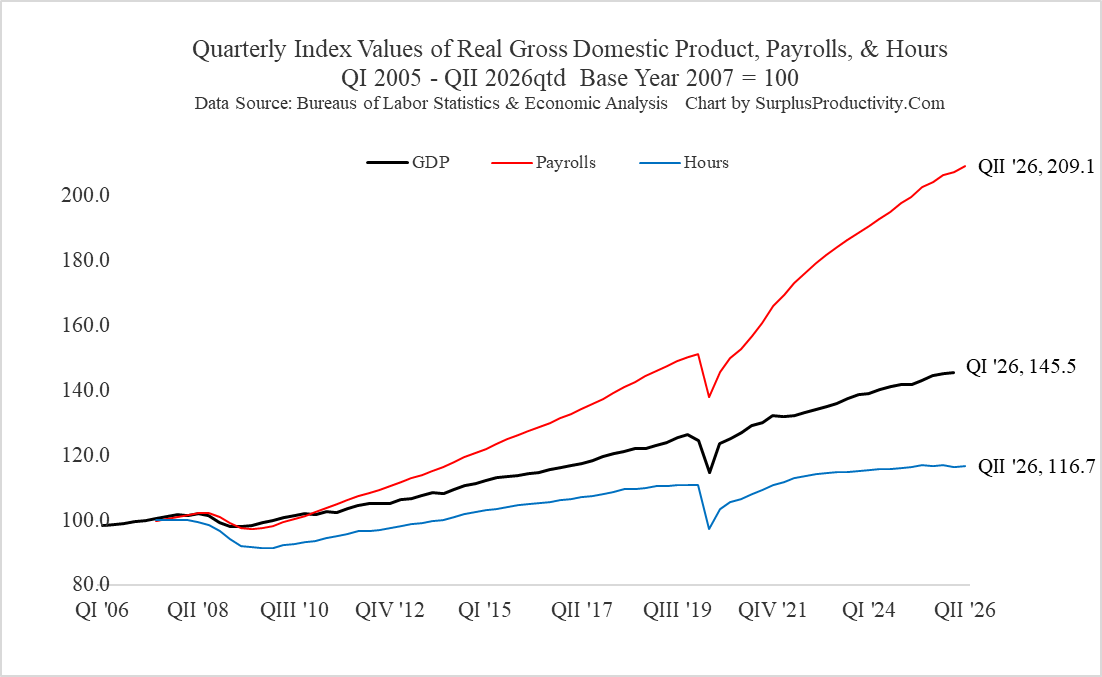
Sure more jobs, but they’re not adding any more work.
The disconnect between a job and work should be a lot easier to understand yet the two very different dynamics are often explained as the same thing. However, anyone who’s ever been on a payroll knows that not all jobs produce the same amount of work. Specifically, work varies in scope and value significantly not only across different sectors in the economy but even throughout the same industry. More so, the economic fundamentals guiding trends in work care little whatsoever for how the payrolls are formed to accomplish it. As a measure of final demand, it is very easy to see that GDP does not react to jobs at all, rather that of the work it took to transform that output from its potential stage to that of final product. Consequently, aggregate weekly hours carries a much stronger correlation to that of GDP than payrolls ever could. More so, with surplus productivity deflating the cost of labor (relative to the potential of the output it produces), it is clear to see that payrolls have little, if any real, economic meaning in the current economic procession. This is evident in the
